
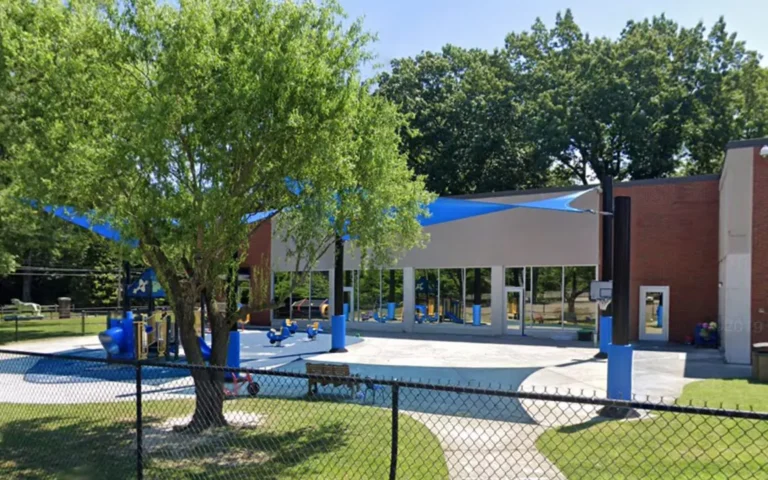
🌟 Key Highlights: University of Memphis Lipman Early Childhood School
The University of Memphis Lipman Early Childhood School is a private, non-profit school in Memphis, Tennessee. Operating as an on-campus laboratory school of the University of Memphis College of Education, it is dedicated to providing high-quality, accredited early childhood education and care while serving as a training and research site for university students and faculty.
🏫 Overview
-
Type: Private / Non-Profit Laboratory School (University-Affiliated)
-
Location: Memphis, Tennessee (University of Memphis Campus)
-
Ages/Grades Served: Infants (6 weeks) – Pre-Kindergarten (PK 4/5)
-
Enrollment: Varies, serving University staff/students and the wider community
-
Core Mission: To provide a model program of excellent early childhood education and developmental care while serving as a resource for teacher training, observation, and research in collaboration with the University of Memphis Department of Instruction and Curriculum Leadership.
-
Affiliation: University of Memphis (U of M), College of Education.
-
Accreditation: Fully accredited by the National Association for the Education of Young Children (NAEYC) and licensed by the State of Tennessee.
-
Focus: Dedicated early childhood education and care, emphasizing play-based learning, developmental appropriateness, and research-informed practice.
✅ What Makes the School Unique?
The Lipman School is distinguished by its unique role as a university laboratory school and its commitment to quality and research:
-
University Laboratory Setting: Its primary purpose is to be a hands-on training and research center for U of M students in child development, special education, and psychology. The curriculum and teaching practices are constantly informed by current academic research.
-
NAEYC Accreditation: Holds the highly respected NAEYC Accreditation, which signifies the highest standards of quality in early childhood development, curriculum, teacher qualifications, and health/safety.
-
Developmentally Appropriate Practice (DAP): The curriculum is focused entirely on developmentally appropriate practice (DAP), emphasizing play-based, hands-on learning tailored to the intellectual, social, emotional, and physical needs of each age group.
-
High Teacher Qualifications: Teachers are typically highly qualified with degrees in early childhood education or related fields, often holding advanced degrees, and are committed to implementing research-based teaching strategies.
-
Comprehensive Care: Offers continuous care and education starting from infancy (6 weeks) through the crucial Pre-Kindergarten year, providing a stable and consistent environment.
-
Small Class Sizes and Favorable Ratios: Adheres to strict, favorable student-to-teacher ratios as required by both NAEYC standards and state licensing, ensuring personalized attention for every child.
📞 Contact Information
| Detail | Information |
| Address | 4500 Poplar Ave, Memphis, TN 38117 (Physical location often near the U of M campus) |
| Phone | (901) 678-2100 (U of M College of Ed contact) |
| Website | memphis.edu/lipman (Associated with the U of M College of Education website) |
Recess Policies
- Which grades at your school receive daily recess or free break periods?
- How are recess and/or free break periods structured? Timing?
Technology / Device Use
- Are cell phones or other personal devices restricted during the school day? What is the policy?
- What are the consequences for violating technology policies?
- Are there any other technology policies? For example, are there technology controls inside and/or outside of school (e.g., web monitoring, filters, etc.)?
Behavior
- What are the school's behavior policies?
- Does the school have a behavior/discipline matrix that lists the behaviors and the appropriate consequences? Could you please include your school’s behavior/discipline matrix?
A school can have discipline/behavior policies, but these policies can be broad. It can be difficult to understand the actual consequences and what actually occurs at school. This section displays the concrete consequences that occur for various behaviors based on teacher feedback. If you are/were a teacher, please email me (Mark Yager) at myager890@gmail.com to give your input. You will remain anonymous when you provide your input.
Explanation of discipline at the school (Summarized based on teachers' input):
| Type of Behavior | Typical Consequence / School Response |
| Tardiness / Late to Class | |
| Dress Code Violation | |
| Failure to Follow Directions / Classroom Rules | |
| Disruption in Class (talking out, off-task behavior, etc.) | |
| Incomplete Homework or Repeated Lack of Effort | |
| Possession or Misuse of Cell Phone / Electronic Device | |
| Disrespect to Teacher / Staff | |
| Use of Inappropriate or Profane Language | |
| Dishonesty / Cheating / Academic Misconduct | |
| Minor Property Misuse or Damage | |
| Bullying / Teasing / Harassment (Verbal or Online) | |
| Defiance / Refusal to Comply with Staff Directives | |
| Leaving Class or Campus Without Permission | |
| Physical Aggression / Fighting | |
| Vandalism or Major Property Damage | |
| Possession of Tobacco or Vaping Device | |
| Possession or Use of Alcohol / Drugs | |
| Threatening Behavior or Intimidation | |
| Possession of a Weapon or Dangerous Object | |
| Other Behavior: | |
| Other Behavior: | |
| Other Behavior: | |
| Other Behavior: |
Sorry, no records were found. Please adjust your search criteria and try again.
Sorry, unable to load the Maps API.